
TL;DR
If you have prayed for months and heard nothing, the silence can start to feel like evidence that God has gone. Scripture says something different. The Bible is full of people who waited on a God who seemed absent, and it never once treats that ache as a failure of faith. The Psalms even hand us prayers that argue with God.
So the way through a silent season is not to pretend it isn't happening. It is to pray honestly, keep opening your Bible when it feels flat, listen for a whisper instead of a shout, remember what God has already done, and wait alongside other people rather than alone. Waiting is not the waiting room of the Christian life. It is often where God does his deepest work.
When God seems silent
You know the shape of it. You have prayed the same prayer so many times it has worn smooth. You have asked for a job, a healing, a child, a marriage to survive, a prodigal to come home. And the ceiling has stayed quiet.
The strange part is that nothing about your circumstances has to be dramatic. Monday arrives and God is still not obviously speaking, and a small, cold thought forms: what if he isn't there?
Here is the first thing worth knowing: that thought is not new, and it is not uniquely yours. It has a home in Scripture, and Scripture does not scold it.
Psalm 13, written by David, opens with a man shouting into exactly this silence. In the King James Version it reads:
How long wilt thou forget me, O LORD? for ever? how long wilt thou hide thy face from me?
Four times in two verses he asks "how long." That is not a tidy devotional voice. It is a man who feels forgotten, arguing his case in the one place he knows to take it.
David's song is in the Bible on purpose. God did not edit the complaint out.
What the Bible says about God's silence
The first honest thing to say about God's silence is that it is a real experience, and the Bible reports it plainly. The psalmist pleads, "O God, do not keep silence; do not hold your peace or be still, O God!" (Psalm 83:1). Job cries out that God does not answer him (Job 30:20). For whole seasons, the people closest to God heard nothing back.
The second thing to say is more surprising. As one writer puts it, there is a sense in which God is never truly silent at all. He has already spoken in his word, and he has spoken most clearly by becoming a man and dying on a cross. What we call God's silence may be, at least sometimes, our own difficulty hearing him (Desiring God, "Waiting When God Seems Silent").
That reframe matters, because it moves the question from "Where is God?" to "What is blocking the signal?" Sometimes it is noise: the endless scroll, the constant news, the exhaustion that leaves nothing in the tank by bedtime. Sometimes it is unwillingness: a part of us that suspects we will not like the answer. Both are worth naming honestly.
And even God's own quiet is not coldness. Zephaniah pictures a God who is not merely loud over his people but still over them:
The Lord your God is in your midst, A victorious warrior. He will exult over you with joy, he will be quiet in his love, he will rejoice over you with shouts of joy.
And when God does speak in the dark, he often does it quietly. Elijah, hiding in a cave and afraid for his life, did not meet God in the wind, the earthquake, or the fire. He met him in "a low whisper" (1 Kings 19:12).
Low whispers are hard to hear when the wind is howling. Which is exactly why the wind around you may need to be turned down before the voice is audible.
One old story captures how easy it is to misread the silence. Martin Luther, sunk in a long discouragement, grew unresponsive and withdrawn. His wife Katherine eventually walked into the room dressed in black mourning clothes. When Luther asked who had died, she answered that it seemed God himself must have died, since he was acting as though God had. The point landed: God had not died, and Luther could stop living as if he had (Desiring God, "Waiting When God Seems Silent").
How to pray when God seems silent
If you are in the middle of it right now, here is a way to pray through it. None of these steps makes God answer on your timetable. What they do is keep you facing the right direction while you wait.
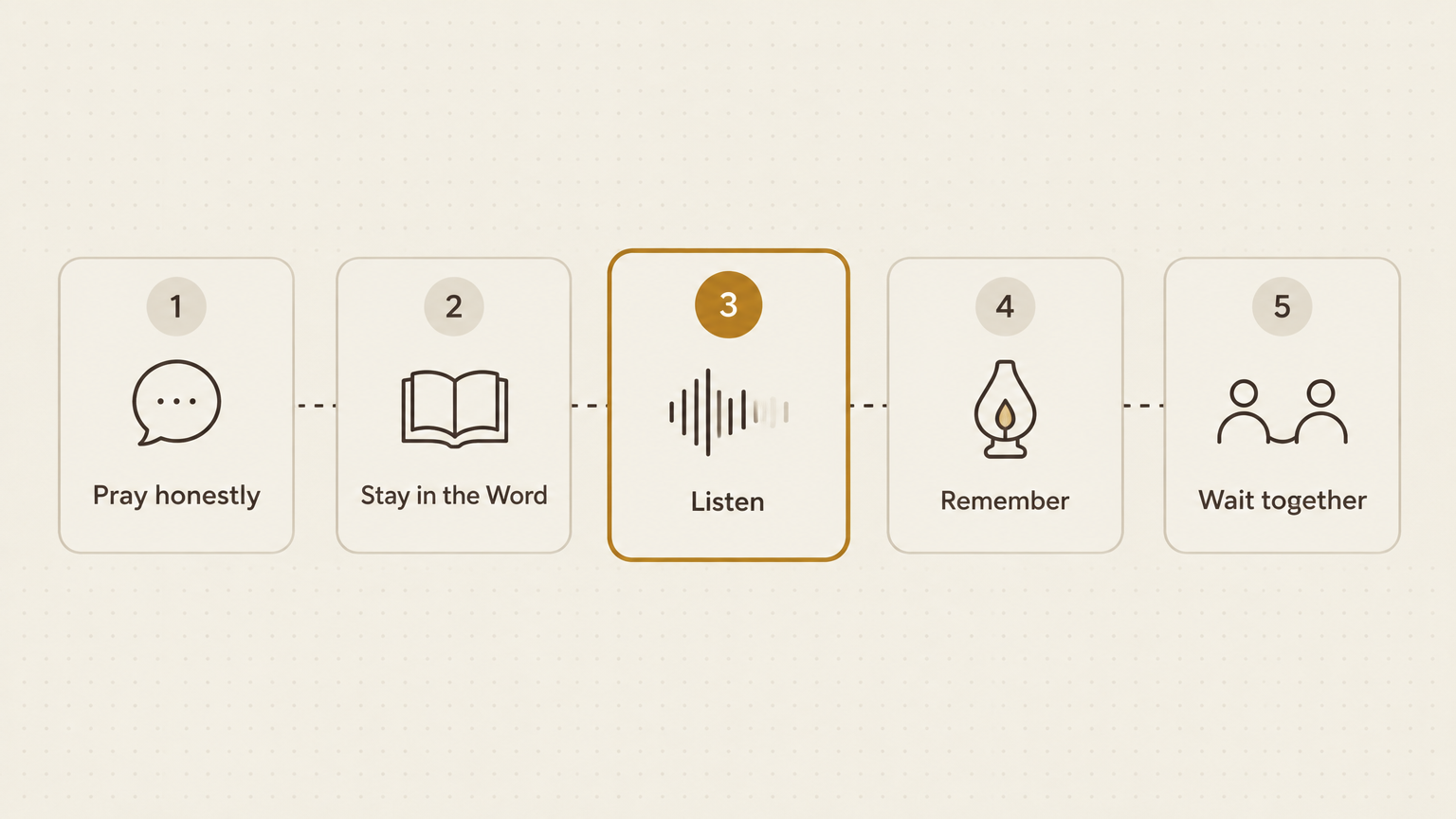
1. Pray honestly, complaint and all
Nothing in Scripture says a prayer has to sound composed. Psalm 13 starts in protest and ends in trust, and it never deletes the protest to get there.
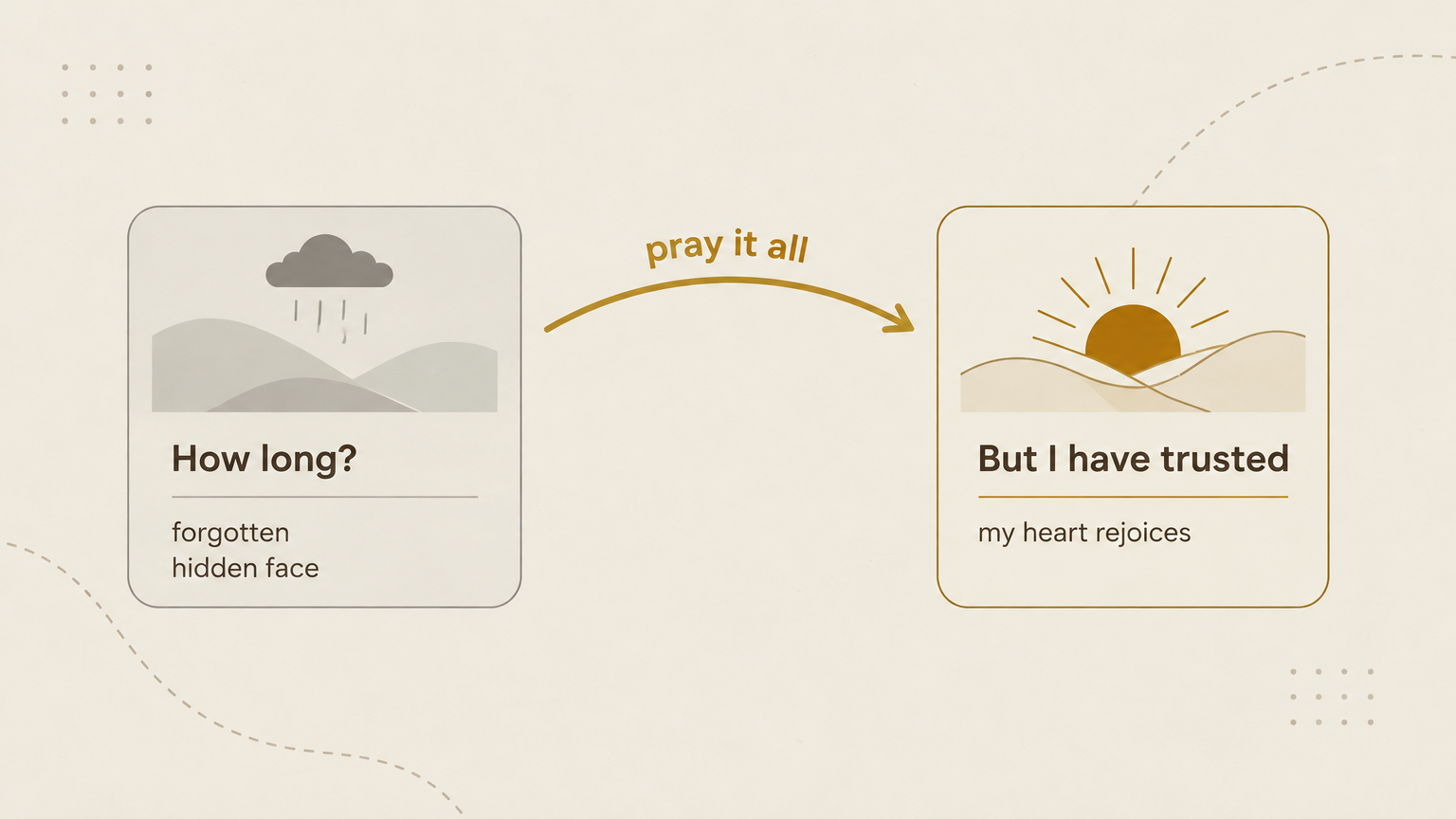
Read how the same psalm finishes:
But I have trusted in thy mercy; my heart shall rejoice in thy salvation.
That is the shape to aim for. Tell God the truth about how abandoned this feels, then keep talking to him anyway. Lament is not the opposite of faith. It is faith speaking to God instead of about him.
2. Keep opening the Word, even when it feels flat
When God feels silent, the instinct is to stop reading. Do the opposite. Keep showing up at the page, day after day, even when nothing lights up, because you are not reading for a feeling. You are reading to look again at what God has already said and done (Desiring God).
Isaiah gives the promise most people memorise first:
But they that wait upon the LORD shall renew their strength; they shall mount up with wings as eagles; they shall run, and not be weary; and they shall walk, and not faint.
Notice what the verse promises. Not a shortcut out of the waiting, but strength inside it.
3. Listen for the whisper, not the shout
We tend to expect God to arrive with volume, in a sign too big to miss. Elijah learned otherwise. God was not in the wind, not in the earthquake, not in the fire. He was in "a low whisper" (1 Kings 19:12).
That changes what you are listening for. Often the work of prayer in a silent season is less about getting an answer and more about lowering the noise until you can hear one. Habakkuk was told to wait for a vision that was slow in coming: "though it tarry, wait for it; because it will surely come" (Habakkuk 2:3, KJV).
4. Remember what God has already done
Waiting erodes memory. In the dark it is easy to forget every earlier kindness of God. So do it on purpose. The psalmist steadies himself by looking back:
I wait for the LORD, my soul doth wait, and in his word do I hope. My soul waiteth for the Lord more than they that watch for the morning.
Write down three times God met you in the past. Then read them back to yourself when the silence gets loud. Ecclesiastes promises that God "hath made every thing beautiful in his time" (Ecclesiastes 3:11, KJV) - his time, which is rarely ours.
5. Wait with other people, not alone
Silence is heavier when you carry it by yourself. Tell one trusted friend the truth about this season, and ask them to pray with you and to notice out loud the places they see God at work in your life, even when you cannot. A pastor described to a friend the months after his teenage son died, when "nearly every morning, for months, I screamed questions at God." Then he added this: "when I became silent, God spoke to my soul" (Desiring God). Even his arrival at stillness was shared, not solo.
Prayers from the Psalms for a silent season
One of the kindest gifts in Scripture is that it hands you words when you have none. These five lines cover most of what a silent season feels like. Read one slowly each morning and make it your own.
| What it feels like | Where to pray it | The words (KJV) |
|---|---|---|
| Forgotten | Psalm 13:1 | "How long wilt thou forget me, O LORD? for ever?" |
| Restless | Psalm 62:5 | "My soul, wait thou only upon God; for my expectation is from him." |
| Watching for dawn | Psalm 130:5-6 | "My soul waiteth for the Lord more than they that watch for the morning." |
| Losing courage | Psalm 27:14 | "Wait on the LORD: be of good courage, and he shall strengthen thine heart." |
| Tired of waiting | Habakkuk 2:3 | "Though it tarry, wait for it; because it will surely come." |
Make one of them into a picture for your phone or a friend's encouragement. It is a small thing, but a verse you keep in front of you is a verse you start to believe.
What the Bible's long waiters teach us
If your wait feels like a sign that something has gone wrong with your faith, look at who else waited. Scripture is full of them, and none of them were second-rate believers being punished with delay (BibleMemory, "Bible Verses About Waiting on God").
| Who | What they waited for | What the wait produced |
|---|---|---|
| Abraham | the promised son | decades of learning to trust a promise he could not yet hold |
| Joseph | release from prison | a character that could be trusted with power |
| David | the throne he had been anointed for | years of learning to wait without grabbing |
| Hannah | a child | a prayer that turned into a vow and a gift |
| Zechariah and Elizabeth | a son in old age | a faith that held when the answer came late |
| Israel | the promised Messiah | centuries of hope kept alive by prophets |
What none of them received was a timeline. God did not tell Abraham how many years, or Hannah how many months. He gave them himself and asked them to keep walking.
That is worth sitting with. The absence of a timeline is not the absence of God. It may be the whole point, because a promise with a date attached only needs patience, while a promise without one needs trust.
Why the waiting is not wasted
The Bible's idea of waiting is not the same as the world's. It is not sitting still and hoping the time passes. The Hebrew picture is closer to a watchman on a wall, straining through the dark for the first sign of morning: "My soul waiteth for the Lord more than they that watch for the morning" (Psalm 130:5-6, KJV).
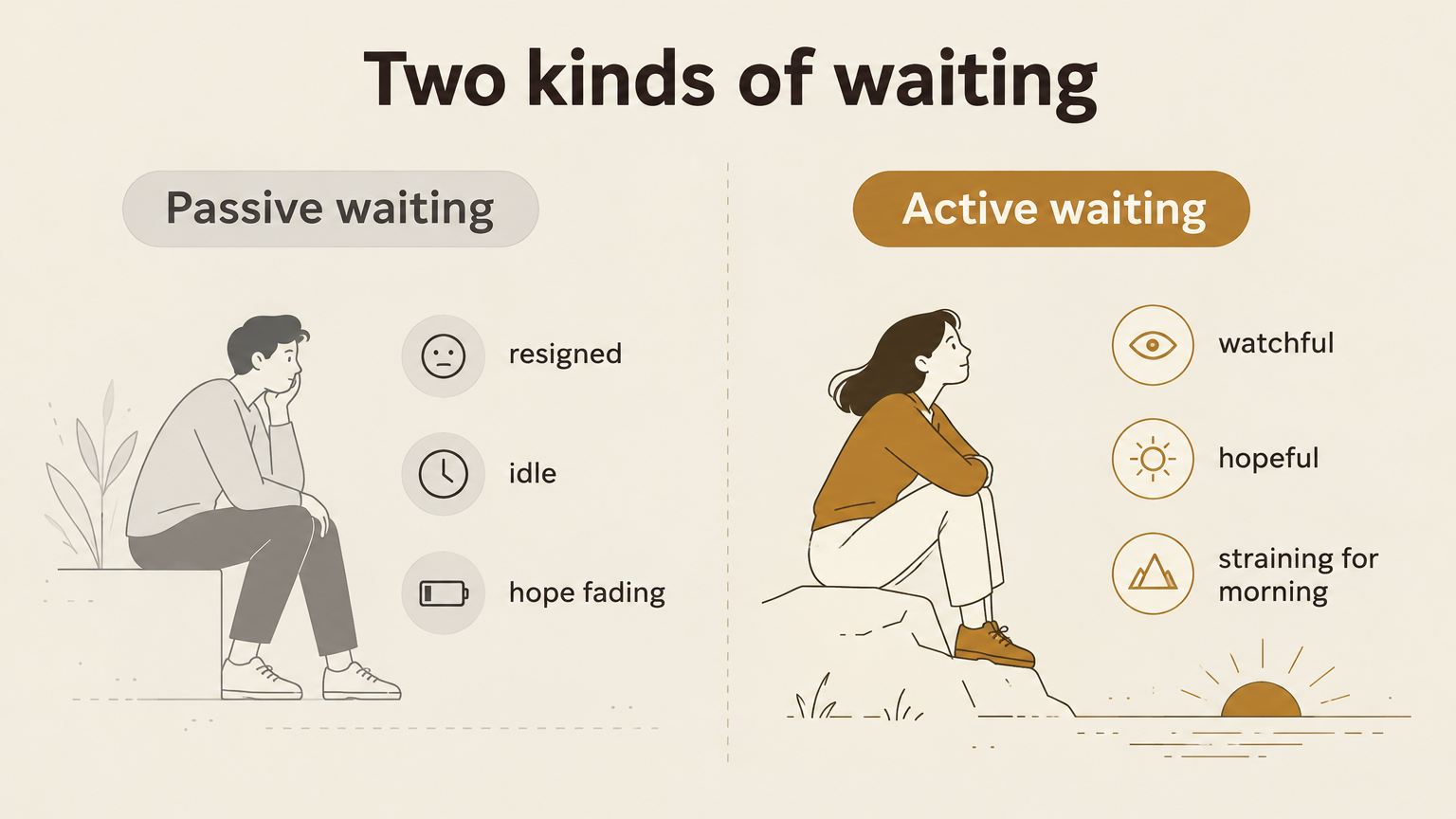
That is active waiting: awake, watchful, expecting. And it rests on a promise most of us have never noticed, because it turns the whole thing upside down. Isaiah 30:18 says that while we wait on God, God is waiting too: "And therefore will the LORD wait, that he may be gracious unto you... blessed are all they that wait for him" (Isaiah 30:18, KJV). You are not waiting on an unwilling God. You are waiting on a God who has chosen the exact moment his kindness will land hardest.
Isaiah 64:4 goes further still: no eye has seen what God "hath prepared for him that waiteth for him" (Isaiah 64:4, KJV). Andrew Murray put the same hope this way in Waiting on God:
It is God's Spirit who has begun the work in you of waiting upon God. He will enable you to wait... Waiting continually will be met and rewarded by God himself working continually.
Andrew Murray, Waiting on God, quoted at Desiring God
So the silence is not a dead zone. It is a workshop. It is where faith stops being a feeling and becomes a foundation, where you find out whether you want God or only his answers. As C.S. Lewis argued about prayers that seem unanswered:
Prayers are not always, in the crude, factual sense of the word, "granted." This is not because prayer is a weaker kind of causality, but because it is a stronger kind. When it "works" at all it works unlimited by space and time. That is why God has retained a discretionary power of granting or refusing it.
C.S. Lewis, God in the Dock, quoted at simply, Christian
If you are in a silent season, you are not being ignored. You are being formed. And the One who seems quiet has not gone anywhere.
Try Daniel Books
If this post helped, the easiest next step is to keep one of these verses in front of you. Daniel Books is a free Bible verse status maker that turns any passage into a shareable image for WhatsApp, Instagram, and Facebook. It carries the King James Version alongside Hindi, Tamil, Spanish, and more, with story, post, and video sizes, so a verse that steadied you in the dark can steady someone else in ten seconds.

Open the Status Maker ➔ and make Psalm 13:5 your screen for the week.
Frequently Asked Questions
What does the Bible say about God being silent?
Scripture treats God's silence as a real experience, not a failure of faith. Psalm 13 asks "How long wilt thou forget me, O LORD?", Psalm 83:1 pleads with God not to keep silence, and Isaiah 30:18 promises that the LORD himself waits to be gracious. The Bible also says God has already spoken in his word and at the cross, so what feels like silence is often our difficulty hearing him.
How do I pray when God seems silent?
Pray honestly, complaint included, the way Psalm 13 does: protest first, then trust. Keep opening your Bible even when it feels flat, listen for the whisper rather than the shout, remember what God has already done, and wait with other people. You can also read more devotional guides that walk through a verse at a time.
Is it a sin to doubt when I can't hear God?
No. The Psalms and Job bring raw questions straight to God, and he keeps those prayers in the Bible. Doubt becomes sin when it quietly turns you away from God, but a complaint spoken to him is faith, not its opposite. Lament is one of the most honest forms of prayer.
How long should I wait on God before giving up?
Scripture never gives a timeline, and that is the point. Abraham waited decades for a promised son, David waited years for a throne, and Israel waited centuries for the Messiah. Waiting is not a waiting room but a workshop, where faith stops being a feeling and becomes a foundation.
What can I do while I wait on God?
Keep one verse in front of you. Daniel Books is a free Bible verse status maker that turns any passage, including Psalm 13:5 and Isaiah 40:31, into a shareable image for WhatsApp, Instagram, and Facebook in the King James Version and several other languages.