
TL;DR
It is late, and your mind will not slow down. That is where this page meets you, and it is where the Bible meets you too: not with a scolding, and not with a promise that the problem disappears, but with a Person who says you are not carrying this alone. Scripture talks about anxiety far more plainly than most of us expect, and it answers it the same way every time.
- For a racing mind, start with Philippians 4:6-7, the verse YouVersion named its most-engaged verse of 2024. Worry is a conversation you have with yourself. Prayer is that same conversation handed to God.
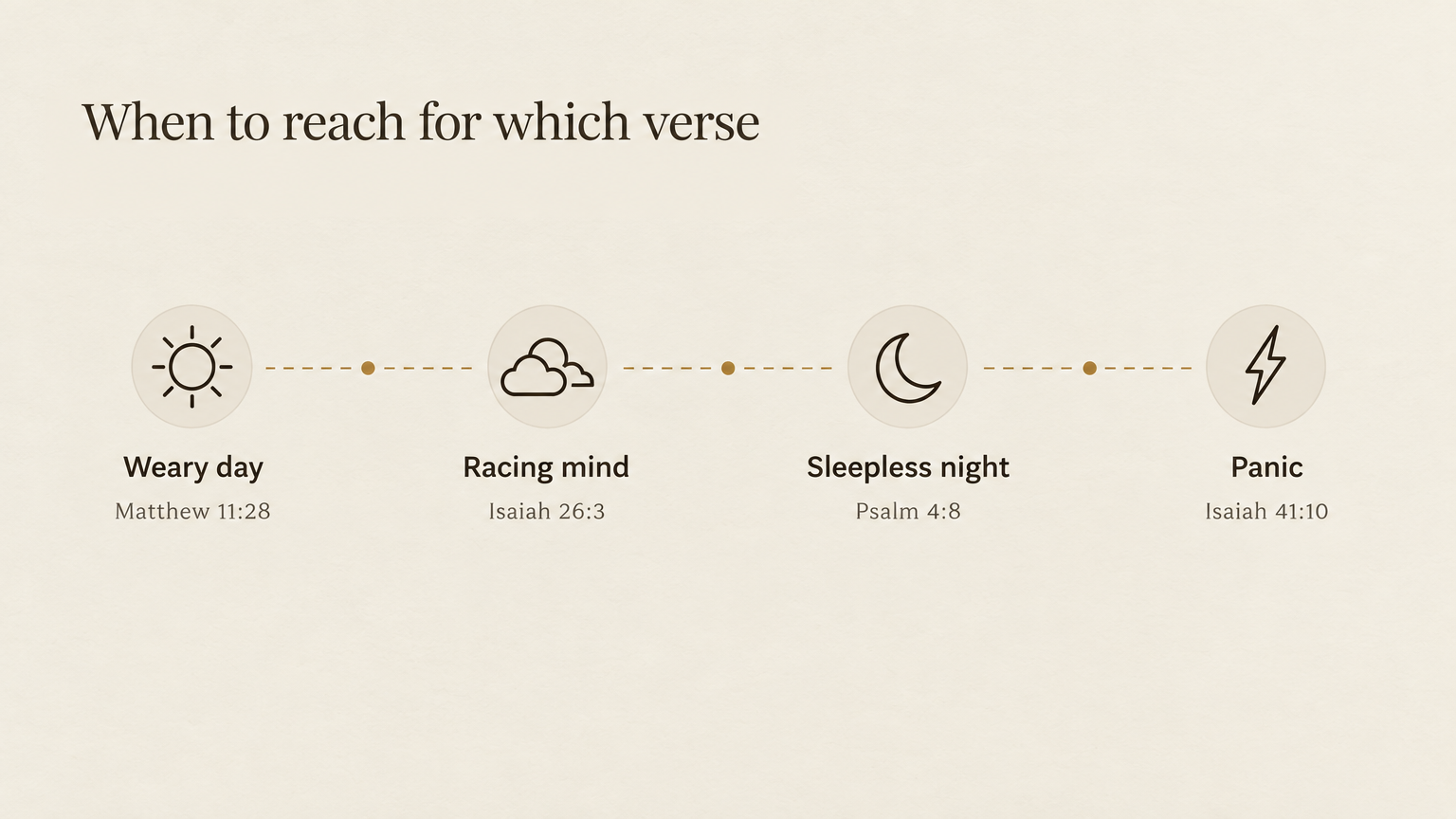
- For a sleepless night, reach for Psalm 4:8 and Psalm 121:3-4. The God who keeps you never sleeps, so you can.
- For panic, hold on to Isaiah 41:10: "Fear thou not; for I am with thee."
- For a weary day, sit down with Matthew 11:28-30: "Come unto me... and I will give you rest."
Read one slowly, out loud if you can, then keep it somewhere you will see it again. And one honest word first: if anxiety is running your days and not only visiting your nights, Scripture sits alongside real help, not instead of it. A doctor, a counsellor, or a crisis line is wisdom, not a lack of faith.
Why the Bible talks about anxiety so plainly
You might expect the Bible to treat anxiety as a small failure of faith, a thing to be scolded out of you. It does not. From the Psalms to the letters of Paul, Scripture names the racing mind, the sleepless night, and the fear that arrives without warning, and it never once acts surprised that you have them.
There is hard evidence that this is where people actually live. Philippians 4:6 was the most-engaged verse of 2024 on YouVersion, the world's most-used Bible app, and the words "prayer" and "peace" were among the most-searched on it that year (Christian Today). People are not searching for trivia; they are searching for something to hold onto.
When they do, they go to the Psalms. In Bible Gateway's 2025 review of its most-read verses, the Psalms took 40 of the top 100, Psalm 23 held the top six places, and Psalm 91 kept all sixteen of its verses in the top twenty-five (Bible Gateway). When people are afraid, they go to the songs. That is not an accident. It is the shape of the whole Bible's answer to fear.
Notice what God's answer is not. It is rarely "nothing is wrong." More often it is "I am with you." The comfort Scripture offers is not the removal of every hard thing, but the presence of God inside it.
The verses below are grouped by the moment you are most likely to need them, so you can go straight to the one that matches your night, or your day.
What Philippians 4:6 really means
This verse deserves more than a glance. Paul writes it from a prison cell, which is worth remembering whenever someone says faith is meant to make life easy.
"Be careful for nothing; but in every thing by prayer and supplication with thanksgiving let your requests be made known unto God. And the peace of God, which passeth all understanding, shall keep your hearts and minds through Christ Jesus."
"Be careful for nothing" does not mean be careless. The older English word "careful" here carries the weight of full of care, and the Greek behind it (merimnate) pictures a mind pulled in different directions at once (Bible Hub). Anyone who has lain awake at 2am knows that feeling. Paul is not telling you to stop caring about your life. He is telling you that the anxious, torn, circling kind of care belongs somewhere other than your own hands.
Two things make the verse more than a slogan. First, it is a command, and commands arrive as offers: stop carrying this, hand it over. As one commentator puts it, undue care "is an intrusion into an arena that belongs to God alone" (Enduring Word). Second is the phrase almost everyone skips: with thanksgiving. Paul does not just say "ask"; he folds the asking inside gratitude, which quietly forces the worry to start losing its grip (Desiring God).
That gives you a pattern you can actually pray through, in four moves.
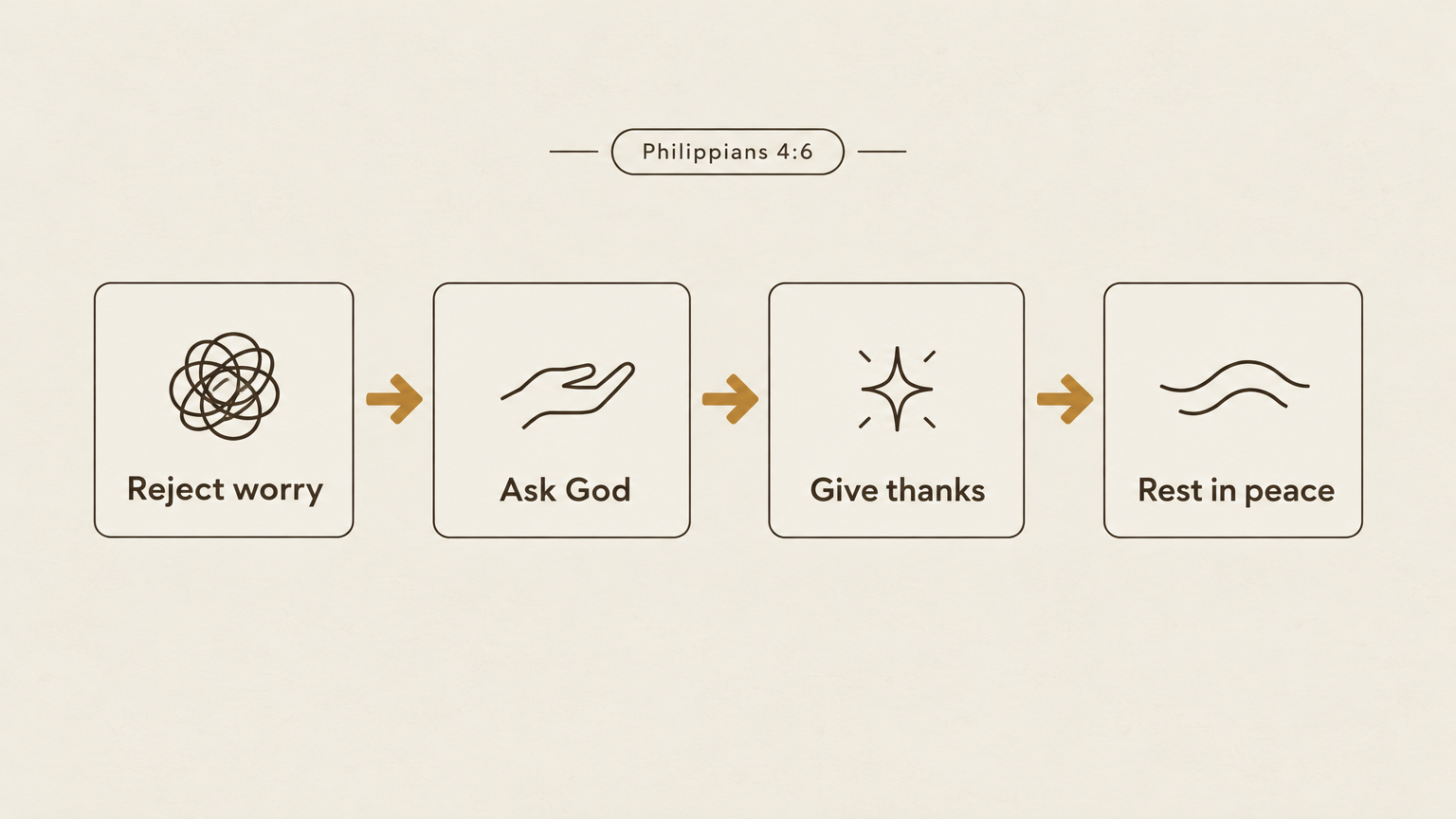
Reject the worry, ask God for what you need, thank him for what he has already done, and then rest in what he has promised. You can do all four in two minutes at your kitchen table.
John Piper puts the difference sharply: "If worry is a conversation we have with ourselves about something we can't do anything about, then prayer is a conversation we have with God about something he can do everything about" (Desiring God).
Want to keep this one where you will see it? Create Status ➔
1. Bible verses for a racing mind
When your thoughts are circling, you do not need a lecture. You need one true sentence to break the loop. These are the verses to reach for when your mind will not sit still.
"Thou wilt keep him in perfect peace, whose mind is stayed on thee: because he trusteth in thee."
Peace here is tied to where the mind is fixed, not to what is happening around you. The promise is not that the storm stops, but that a mind anchored in God is kept steady through it. When to reach for it: when your thoughts are jumping and you need to choose the one thing to fix them on.
"For God hath not given us the spirit of fear; but of power, and of love, and of a sound mind."
This verse does something quietly freeing: it tells you where fear is not from. A sound mind is a gift God gives, not a personality trait you are failing to produce. When to reach for it: when the spiral starts to feel bigger than you and you need to name out loud what is, and is not, from God.
"In the multitude of my thoughts within me thy comforts delight my soul."
Notice that the psalmist does not deny the crowd of thoughts. He says God's comfort meets him inside them, not only after they stop. When to reach for it: in the small hours, when the thoughts multiply and you cannot switch them off.
Reach for one of these the next time your mind spins. Create Status ➔
2. Bible verses for a sleepless night
Worry does its best work at night, when the house is quiet and nothing distracts you. Scripture knows this hour, and has verses written for the dark.
"I will both lay me down in peace, and sleep: for thou, LORD, only makest me dwell in safety."
David lies down in peace before he is asleep, not after. Safety is something God does, not something you have to achieve before you are allowed to rest. When to reach for it: when you finally turn off the light and the quiet feels loud.
"He will not suffer thy foot to be moved: he that keepeth thee will not slumber. Behold, he that keepeth Israel shall neither slumber nor sleep."
This is the verse for the 3am feeling that no one is watching over the night but you. God is not asleep. Your watch shift is over; his is not. When to reach for it: when you are lying awake convinced the responsibility for holding everything together is yours alone.
"It is of the LORD'S mercies that we are not consumed, because his compassions fail not. They are new every morning: great is thy faithfulness."
Lamentations is a book of grief, and this is the line that shines through the middle of it. Mercy does not arrive in one big lump; it arrives fresh each morning, matched to the day. When to reach for it: at dawn, when last night's weight is still sitting on you.
Keep one of these by your bed. Create Status ➔
3. Bible verses for the panic
Panic is different from worry. It comes fast, it comes in the body, and it does not wait for you to be ready. For those moments, you want verses short enough to say between breaths.
"Fear thou not; for I am with thee: be not dismayed; for I am thy God: I will strengthen thee; yea, I will help thee; yea, I will uphold thee with the right hand of my righteousness."
Count the promises in one sentence: I am with you, I am your God, I will strengthen you, I will help you, I will hold you up. When everything feels like it is falling, this is a hand under you. When to reach for it: in the moment the chest tightens and the fear arrives before any thought does.
"I sought the LORD, and he heard me, and delivered me from all my fears."
Fear here is not something to be managed. It is something to be delivered from. That is a bigger promise than coping, and it is the one David actually records. When to reach for it: when you need to remember that this is survivable, and that God hears.
"What time I am afraid, I will trust in thee."
Eleven words, and you can say them on one breath. Notice the psalmist does not wait to stop being afraid before he trusts. When to reach for it: right in the middle of the fear, as something to repeat until your breathing slows.
Carry one of these on your phone, so it is there before you need it. Create Status ➔
4. Bible verses for the weary day
Anxiety is exhausting. After enough nights of it, the tiredness settles into the body and the soul at once. These are the verses for running on empty.
"Come unto me, all ye that labour and are heavy laden, and I will give you rest. Take my yoke upon you, and learn of me; for I am meek and lowly in heart: and ye shall find rest unto your souls. For my yoke is easy, and my burden is light."
Jesus does not ask the tired to try harder. He asks them to come. The invitation is for anyone carrying a weight, and the promise is rest for the soul, not just a day off. When to reach for it: when you are tired in a way that sleep alone does not fix.
"Casting all your care upon him; for he careth for you."
The word "casting" is an action. It is a deliberate throw, not a slow leak of worry. And the reason is not that God is obliged to help. It is that he cares. When to reach for it: when you realise you have been carrying something heavy entirely by yourself.
"Peace I leave with you, my peace I give unto you: not as the world giveth, give I unto you. Let not your heart be troubled, neither let it be afraid."
The world's peace is a break, a scroll, a weekend, and it fades the moment you pick the worry back up. Christ's peace is different in kind, and he leaves it as a gift. When to reach for it: when everything you have tried for relief has not held.
End the day differently tonight. Create Status ➔
Keep one verse where you will actually see it

A verse you read once is a nice thought. A verse you keep in front of you starts to change what you believe. Anxiety runs on repetition: the same thought, returning until it feels like the truth. Scripture works the same way in the other direction. You do not need a routine to start, only one verse and one place to keep it. Here are three that take less than a minute each:
- 📌 A picture on your phone. Turn the verse into a status image and set it as your lock screen, so it is the first thing you see when the worry wakes you. Open the Status Maker ➔
- 📌 A message to a friend. Send the verse to someone who is also having a hard week. Encouragement you give away tends to come back around.
- 📌 A note by the bed. Write the words out by hand. There is something about the slow work of writing that settles a thought in a way reading never quite does.
When a verse is not enough: getting real help
We have to be honest here. Sometimes anxiety moves beyond the normal worry that visits everyone into something that shapes your whole day. The health bodies draw the line in almost the same place: anxiety becomes a clinical concern when it is persistent, hard to control, and gets in the way of ordinary life (NHS, WHO).
The signs are worth knowing. If any of these sound like your life rather than your week, that is not a spiritual failure. It is a signal.
| What you might notice | Why it is worth acting on |
|---|---|
| Worry you cannot switch off, most of the day, for weeks or months | The clinical marker for generalised anxiety is feeling anxious a lot of the time for at least six months (NHS) |
| Trouble sleeping or eating, or panic that arrives without warning | Physical and mental symptoms are common, and a panic attack usually passes within 5 to 20 minutes (NHS) |
| Avoiding places or people you used to be fine with | Anxiety disorders lead people to avoid the situations that make them anxious (WHO) |
| Anxiety getting in the way of work, relationships or self-care | This is the line that turns ordinary worry into something worth treating (NIMH, Mind) |
And it is a signal to act on. As the World Health Organization puts it, "There are several effective treatments for anxiety disorders. People with symptoms of anxiety should seek care" (WHO). Speaking to a doctor or a counsellor is not a step away from your faith. It is one of the ways God gives help, the same way he gives medicine, friendship, and rest. If you or someone you know is in crisis or having thoughts of self-harm, contact your local emergency services or a crisis helpline right away; in the US you can call or text 988, and in the UK and many other countries your health service lists national crisis lines.
Keep praying. Keep reading. And get the help. The two are not in competition.
Try Daniel Books
If this post helped, the simplest next step is to keep one of these verses in front of you instead of letting it drift away by morning. Daniel Books is a free Bible verse status maker: it turns any passage into a shareable image for WhatsApp, Instagram, and Facebook. It carries the King James Version alongside Hindi, Tamil, Spanish, French, Portuguese, and German, with story, post, and video sizes, so a verse that steadied you in the dark can steady someone else in ten seconds.

Launch Daniel Books Status Maker ➔ and make Philippians 4:6 your screen for the week.
Frequently Asked Questions
What is the best Bible verse for anxiety?
Philippians 4:6-7 is the one most people reach for, and it is the verse YouVersion named its most-engaged verse of 2024: Be careful for nothing; but in every thing by prayer and supplication with thanksgiving let your requests be made known unto God. If you want it in front of you, you can turn it into a status image in one tap.
What does Philippians 4:6 mean?
The KJV's "Be careful for nothing" does not mean be careless. The older word means full of care, and the verse tells you to stop carrying that anxious, torn kind of worry yourself and hand it to God, asking "with thanksgiving." The post above breaks it into four simple moves you can pray in two minutes.
What Bible verse helps you sleep at night?
Psalm 4:8 is written for exactly this: I will both lay me down in peace, and sleep: for thou, LORD, only makest me dwell in safety. Psalm 121:3-4 follows it well, promising that the God who keeps you will not slumber. Make Psalm 4:8 a card for your lock screen so it is the last thing you see at night.
How do you pray when you are too anxious to pray?
Keep it short and turn it into a pattern: reject the worry, ask God for what you need, thank him for what he has already done, and rest in what he has promised. Psalm 56:3 is a whole prayer in eleven words: What time I am afraid, I will trust in thee.
Is it a lack of faith to see a doctor or take medication for anxiety?
No. As the World Health Organization puts it, "There are several effective treatments for anxiety disorders. People with symptoms of anxiety should seek care." Scripture sits alongside professional help, not instead of it, and talking to a doctor or counsellor is one of the ways God gives help. If anxiety is affecting your daily life, that is a signal to act, not a spiritual failure.