TL;DR
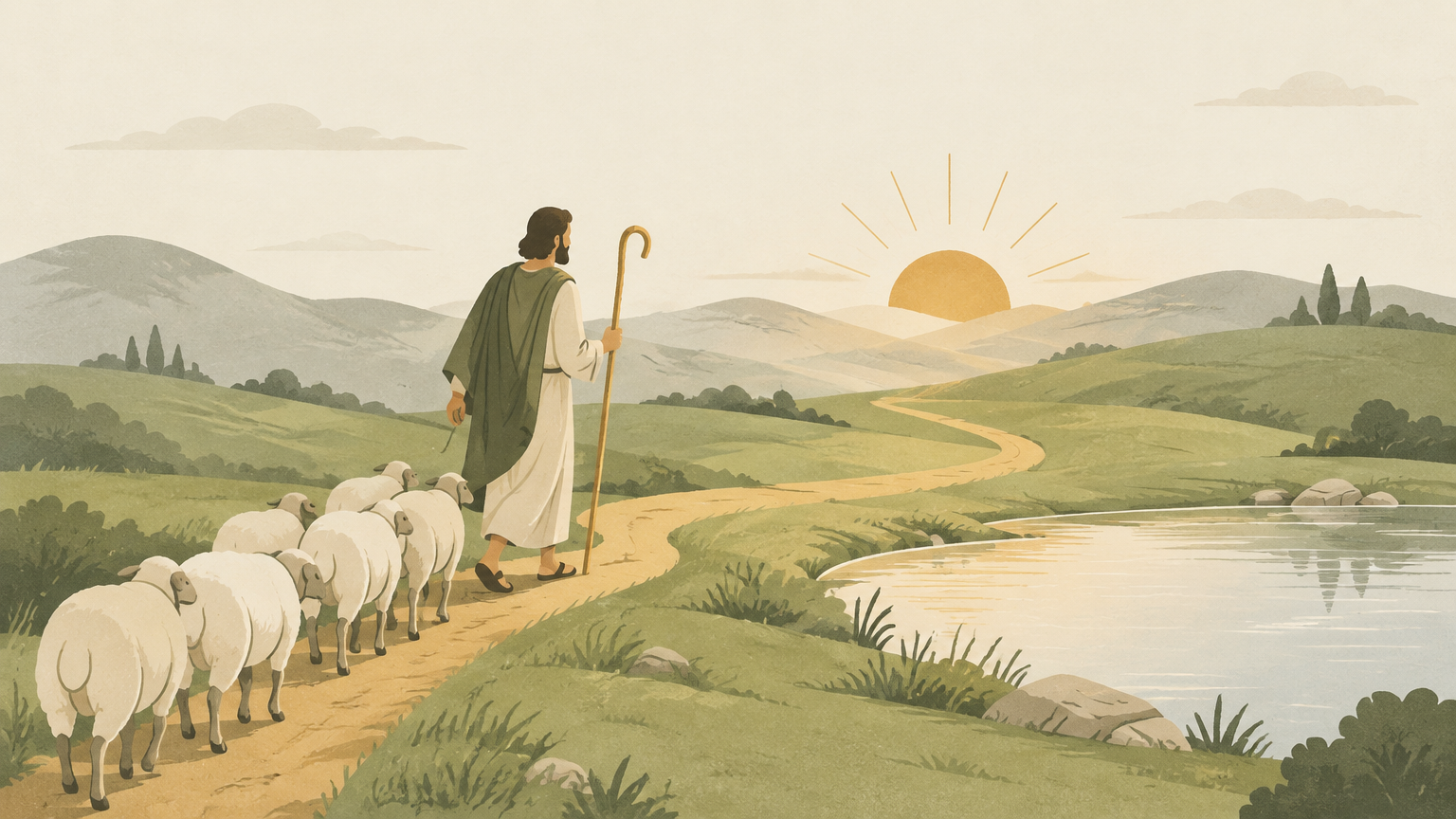
Psalm 23 is the most-read passage in the world. In Bible Gateway's 2025 Year in Review, the top six most-read verses were all from Psalm 23, and it has held that place for years. David wrote it as a shepherd who became a king, and it is really two pictures in one: verses 1 to 4 show God as a shepherd who provides, leads, restores, and stays with you through the darkest valley; verses 5 and 6 turn him into a host who seats you at a table and then sends goodness and mercy chasing after you for the rest of your life.
Here is the whole psalm in a line each. "I shall not want" means you will lack nothing you truly need. "He maketh me to lie down" is God insisting on your rest. "He restoreth my soul" is God turning you back when you have wandered. "Thy rod and thy staff" are his protection and his guidance. "My cup runneth over" is abundance, not just enough. And "shall follow me" is the Hebrew word radaph, which means to pursue, to chase, to hunt down. Nothing about this psalm is distant or tame. It is about a Shepherd who will not let you go.
If you came here afraid, grieving, or worn out, read it slowly and let each verse do its work. When one line steadies you, you can turn it into a picture and keep it where you will see it.
Why Psalm 23 is the most-read passage in the world
Every year, Bible Gateway and YouVersion publish the verses the world reads most, and Psalm 23 keeps winning. Bible Gateway reports that the psalm held the top six spots in its Top 100 verses for 2025, which tells you something worth knowing: readers are not coming for one favourite line, they are reading the whole psalm, start to finish (Bible Gateway).
| Rank | Most-read verse of 2025 |
|---|---|
| 1 | Psalm 23:4 - "for thou art with me" |
| 2 | Psalm 23:1 - "The LORD is my shepherd" |
| 3 | Psalm 23:6 - "goodness and mercy shall follow me" |
| 4 | Psalm 23:5 - "my cup runneth over" |
| 5 | Psalm 23:3 - "he restoreth my soul" |
| 6 | Psalm 23:2 - "he leadeth me beside the still waters" |
Part of the reason is who wrote it. The title says "A Psalm of David," and David had been a shepherd before he was a king (1 Samuel 16:11). He knew what it cost to find green grass on dry hills, to fight off a lion and a bear for the sake of one sheep, to carry a lamb that had wandered away. When he calls God his shepherd, he is not reaching for a pretty metaphor. He is describing the work he knew best.
The other reason is Jesus. He took this psalm onto himself: "I am the good shepherd: the good shepherd giveth his life for the sheep" (John 10:11). So for a Christian reader, Psalm 23 is not only David's song. It is a portrait of Christ, drawn a thousand years before he came.
💡 Discover a verse that speaks to your heart today? Use our free Bible Verse Status Maker to turn Psalm 23 into a custom image for WhatsApp, Instagram, and Facebook, in English (KJV), Hindi, Tamil, Spanish, and more. Open Status Maker ➔
Psalm 23 explained: the meaning of each verse
Psalm 23 is only six verses, but it moves. It begins in a pasture, walks through a valley, sits down at a table, and ends at home. This is the whole journey at a glance.
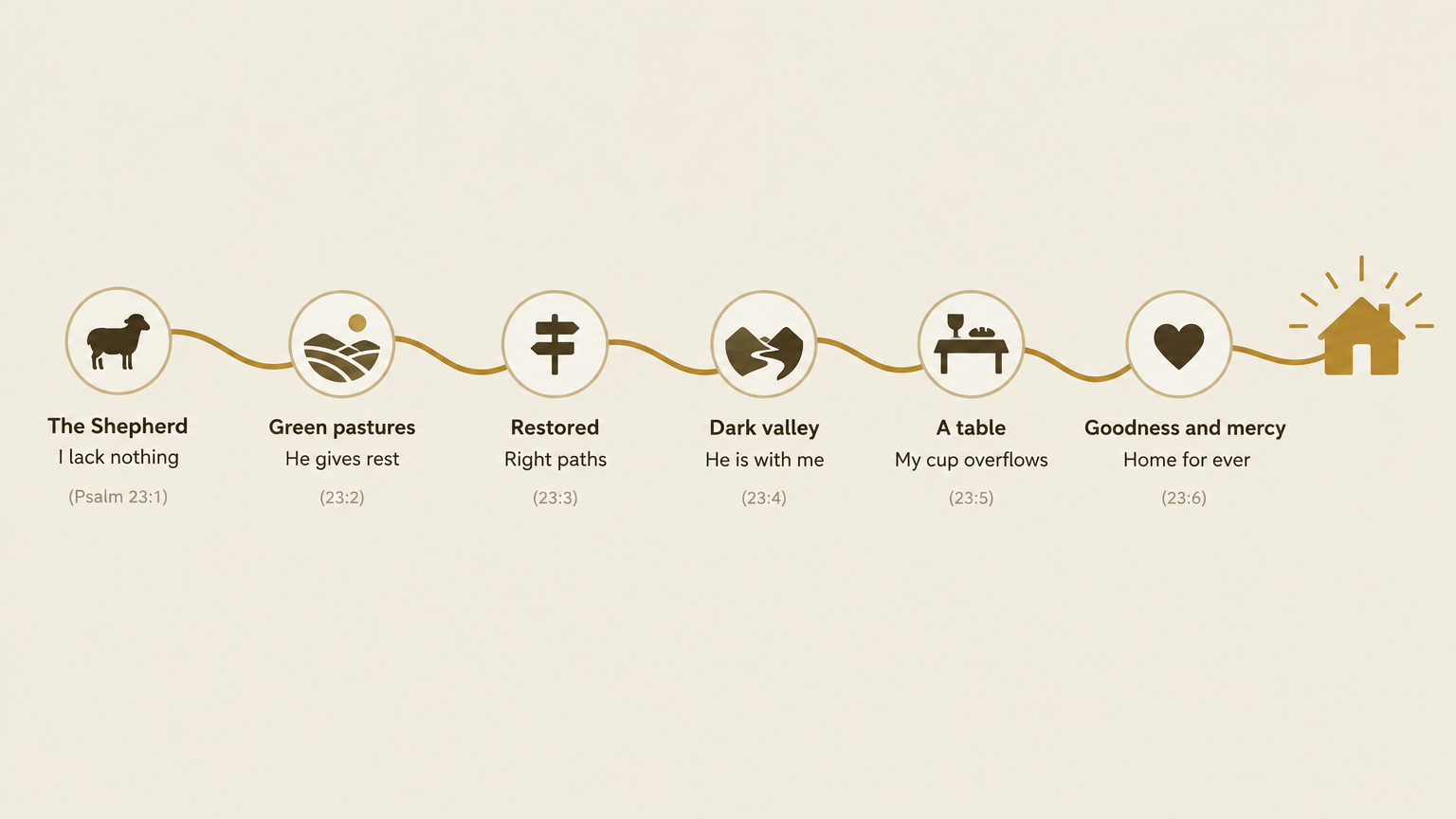
Read it slowly, one verse at a time. Do not rush to the end.
1. "The LORD is my shepherd; I shall not want." (Psalm 23:1)
"The LORD is my shepherd; I shall not want." - Psalm 23:1
What does "The LORD is my shepherd" mean? It means David is not merely agreeing that God exists and is powerful. He is saying God is his, personally, and that the care of his life rests on a shepherd's shoulders rather than on his own.
The word "want" here does not mean desire. It means lack. "I shall not want" is "I will not be in need." Sheep cannot find their own water or defend themselves; they depend entirely on the shepherd, and David is at peace with that. The promise is not that you will get everything you want. It is that you will not go without what you truly need.
Try this today: Name the one thing you are afraid you will not have, the money or the job or the healing or the friend. Then say verse 1 over it, slowly, with your own name in it.
2. "He maketh me to lie down in green pastures: he leadeth me beside the still waters." (Psalm 23:2)
"He maketh me to lie down in green pastures: he leadeth me beside the still waters." - Psalm 23:2
A shepherd will tell you that a sheep will not lie down when it is frightened, hungry, or being tormented by flies. Rest is the proof that everything else has been handled. So the first thing this shepherd gives his sheep is not a task. It is rest.
"Still waters" is literally "waters of rest," not a river you have to fight, but a quiet pool you can drink from safely. Notice that God has to make the sheep lie down. Left to ourselves, we keep standing, keep working, keep scrolling. He knows what we need better than we do.
Try this today: Put one hour of rest into your day on purpose, before you are forced to take it. Let it be a small act of trust.
3. "He restoreth my soul: he leadeth me in the paths of righteousness for his name's sake." (Psalm 23:3)
"He restoreth my soul: he leadeth me in the paths of righteousness for his name's sake." - Psalm 23:3
The Hebrew word behind "restoreth" is shub, which means to turn back, to return, to bring home again. Picture a sheep that wandered after greener grass and ended up on a ledge. The shepherd does not scold it from a distance; he goes and brings it back. To restore your soul is to be turned back to where you belong (BibleRef).
"Paths of righteousness" means right paths, and the shepherd leads them. The sheep does not need to know the route. It only needs to know where the shepherd is.
And the reason is not your worth. It is "for his name's sake," his own character and reputation, that stands behind the promise.
Try this today: Ask God to turn you back from whatever has pulled you off course this week. Name it plainly, and come home.
4. "Yea, though I walk through the valley of the shadow of death, I will fear no evil: for thou art with me; thy rod and thy staff they comfort me." (Psalm 23:4)
"Yea, though I walk through the valley of the shadow of death, I will fear no evil: for thou art with me; thy rod and thy staff they comfort me." - Psalm 23:4
This is the verse the world reads more than any other (Bible Gateway), and it is the hinge of the psalm, because something changes here. For three verses David has been talking about God: "he leads," "he restores." Now he turns and talks to him: "thou art with me." In the dark, the shepherd stops being a subject and becomes a companion.
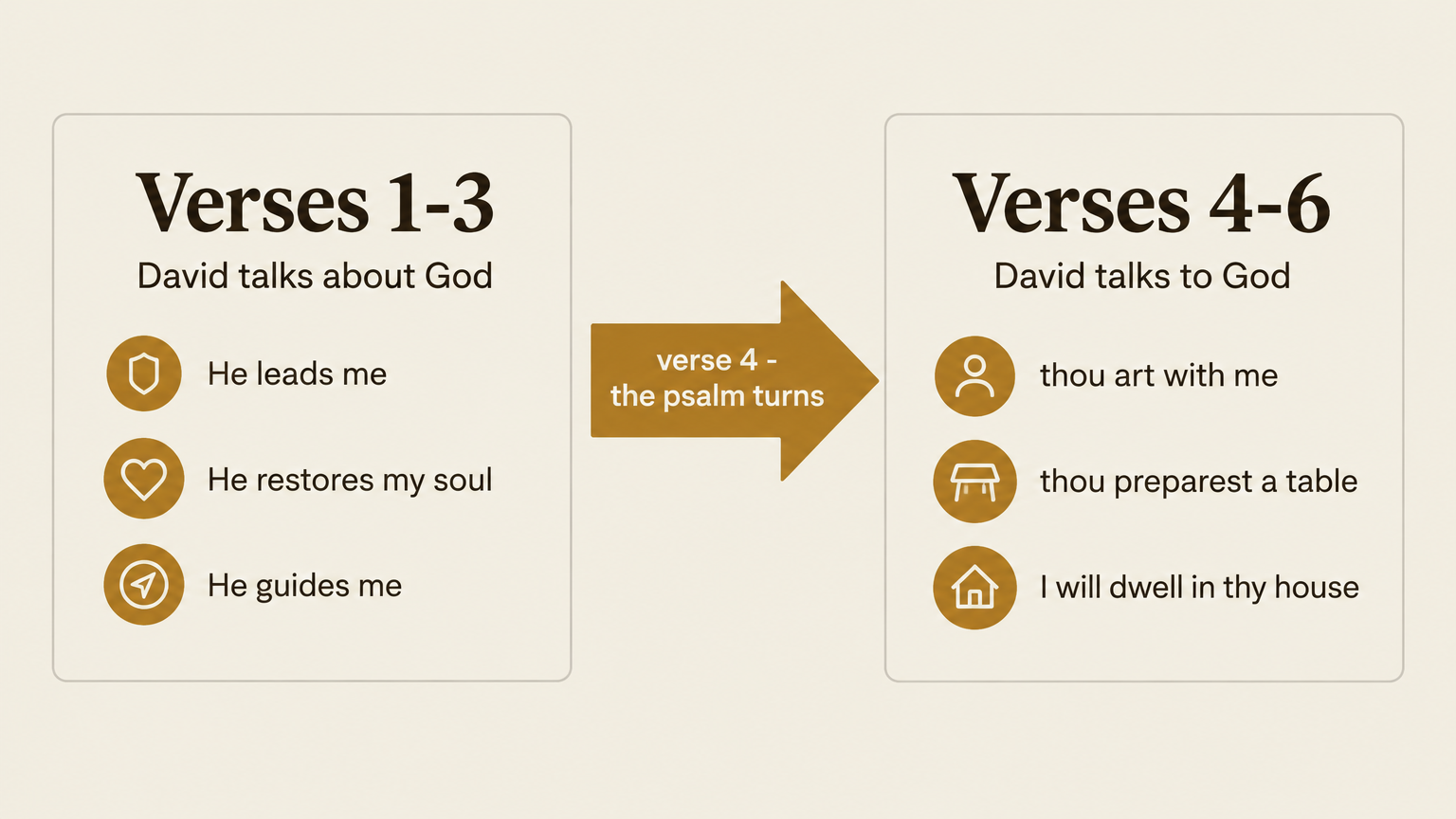
Look at what the psalm does not say. It does not say there is no valley. It does not say you will go around it. It says you walk through it, and that you are not alone in it. The comfort is not the absence of danger but the presence of the shepherd.
"Thy rod and thy staff" are his two pieces of equipment: a sturdy club to drive off predators, and a long hooked staff to guide the flock and pull a wandering sheep back to safety. Protection and guidance, together, in the same hand (GotQuestions).
Try this today: When the fear rises, do not only remind yourself of facts about God. Say it out loud, to him: "thou art with me."
5. "Thou preparest a table before me in the presence of mine enemies: thou anointest my head with oil; my cup runneth over." (Psalm 23:5)
"Thou preparest a table before me in the presence of mine enemies: thou anointest my head with oil; my cup runneth over." - Psalm 23:5
The picture shifts. God has gone from shepherd to host, and the pasture has become a banquet. Notice where the table is set: "in the presence of mine enemies." God does not wait until the danger clears before he feeds you. He sets the table in the middle of it.
Anointing the head with oil was what a host did for an honoured guest, and what a shepherd did for a sheep's wounds and to keep the flies away. Then the cup is not merely filled; it runs over. This is not the language of survival. It is the language of overflow.
Try this today: Sit down before your problem instead of running from it. Name three ways God has already been generous to you this week, and let the cup be the one too full to hold.
🎨 Create Status ➔ and set the table in the middle of your week.
6. "Surely goodness and mercy shall follow me all the days of my life: and I will dwell in the house of the LORD for ever." (Psalm 23:6)
"Surely goodness and mercy shall follow me all the days of my life: and I will dwell in the house of the LORD for ever." - Psalm 23:6
"Follow" is too quiet a word for what the Hebrew says. The word is radaph, and it means to pursue, to chase, to hunt down. Elsewhere in the Old Testament it is the word used of enemies chasing Israel down (Pastor Joe Skogmo). David turns it into a promise: it is not enemies hunting you. It is God's goodness and mercy, chasing after you every day of your life.
Not only on the good days. "All the days." And then the psalm ends the way all true homes do, not with activity but with dwelling: "I will dwell in the house of the LORD for ever." The flock is home.
Try this today: Take five minutes and look for one place goodness and mercy caught up with you this week. Write it down, so you do not forget it.
What the shepherd gives you in Psalm 23
Read past the poetry and Psalm 23 is a list of gifts from a shepherd who knows his flock.
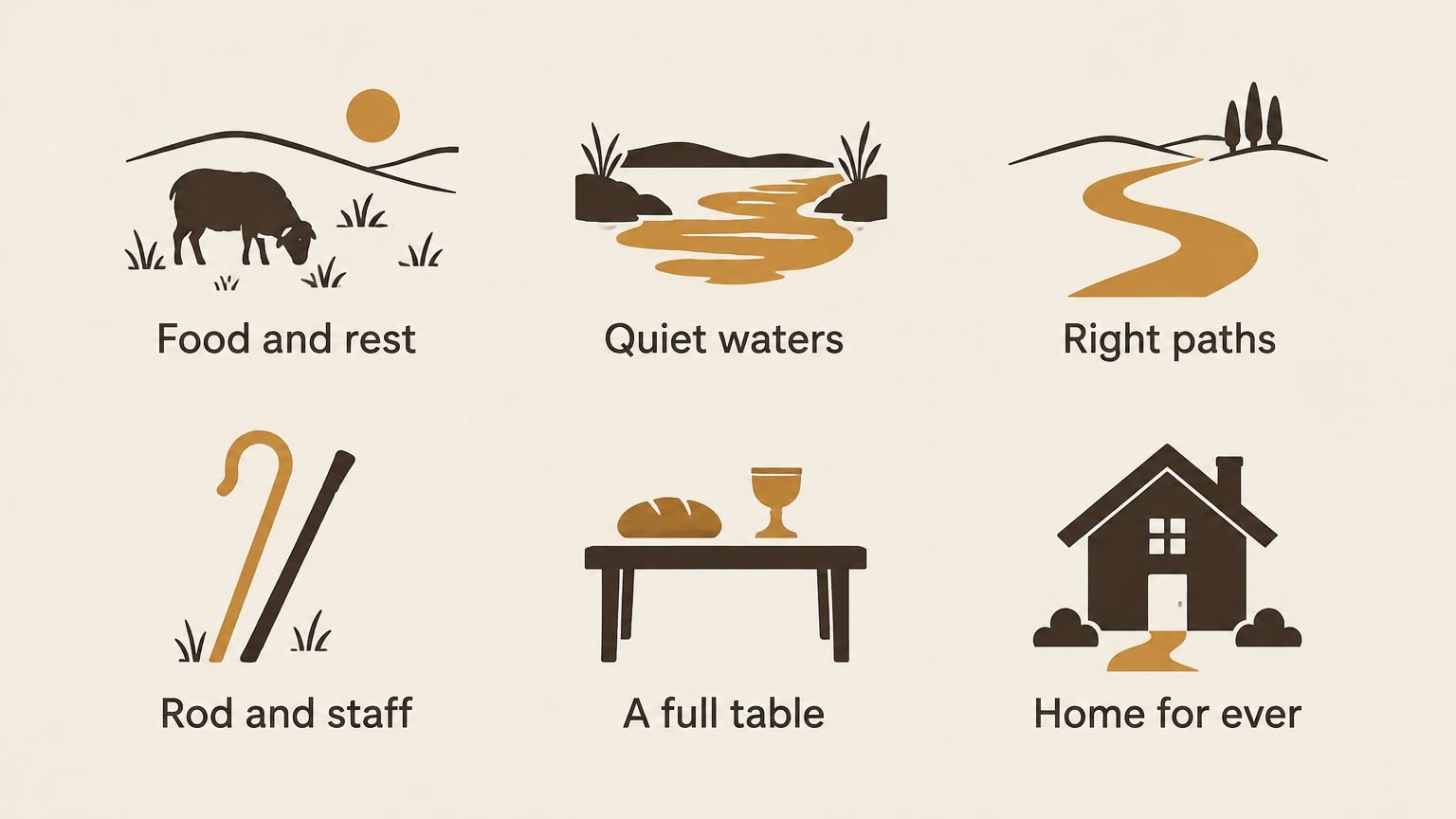
- Food and rest. Green pastures, and the ability to lie down in them (verse 2).
- Quiet waters. Not just water, but the safety to drink it (verse 2).
- Right paths. Guidance for the direction of your life (verse 3).
- Protection and rescue. The rod and the staff (verse 4).
- Honour and abundance. The table, the oil, and the overflowing cup (verse 5).
- A home. Goodness and mercy pursuing you all the way to the house of the LORD (verse 6).
How to pray Psalm 23 in a hard season
One of the kindest things about this psalm is that it gives you words for almost any need. Find the line that matches where you are, and pray it slowly.
| What you feel | The verse | The line to pray (KJV) |
|---|---|---|
| Afraid you will not have enough | Psalm 23:1 | "The LORD is my shepherd; I shall not want." |
| Exhausted and unable to rest | Psalm 23:2 | "He maketh me to lie down in green pastures." |
| Worn down, far from where you should be | Psalm 23:3 | "He restoreth my soul." |
| Walking through the darkest valley | Psalm 23:4 | "Thou art with me; thy rod and thy staff they comfort me." |
| Facing enemies, surrounded | Psalm 23:5 | "Thou preparest a table before me in the presence of mine enemies." |
| Longing for the end of the road | Psalm 23:6 | "I will dwell in the house of the LORD for ever." |
Make one of these lines into a picture for your phone, or send it to someone who needs it this week. A verse you keep in front of you is a verse you start to believe. Explore preset verses ➔
Try Daniel Books
If this post helped, the easiest next step is to keep one of these verses in front of you. Daniel Books is a free Bible verse status maker that turns any passage into a shareable image for WhatsApp, Instagram, and Facebook. It carries the King James Version alongside Hindi, Tamil, Spanish, and more, with story, post, and video sizes, so a verse that steadied you in the valley can steady someone else in ten seconds.

Open the Status Maker ➔ and make "The LORD is my shepherd" your screen for the week.
Frequently Asked Questions
What does Psalm 23 mean?
Psalm 23 is David's song picturing God as a shepherd who provides, guides, and protects his people. The first four verses describe the shepherd's care, and the last two picture God as a host whose goodness and mercy chase after us all our days. See our verse-by-verse guide for the full meaning.
What is the meaning of 'The LORD is my shepherd'?
'The LORD is my shepherd' means God is personally responsible for caring for you, the way a shepherd is for his sheep. 'I shall not want' means you will lack nothing you truly need, not that you will get everything you want.
What does 'thy rod and thy staff they comfort me' mean?
The rod was a shepherd's club for driving off predators, and the staff was a long hooked stick for guiding and rescuing sheep. Together they picture God's protection and his guidance, which is why David calls them a comfort in the valley of the shadow of death.
What does 'my cup runneth over' mean?
'My cup runneth over' means God's provision is more than enough, an overflow rather than bare survival. It follows the table and the anointing oil in Psalm 23:5, a picture of lavish hospitality set in the presence of enemies.
What does 'surely goodness and mercy shall follow me' mean?
The Hebrew word translated 'follow' is radaph, which means to pursue or chase. So the promise is stronger than it sounds: God's goodness and mercy do not trail politely behind you, they chase you down every day of your life. Make it into a status image and keep it in front of you.